

A new construction home warranty is the builder’s written promise to repair covered defects in a newly constructed home, usually following a 1-2-10 structure. That means one year of workmanship and materials coverage, two years of systems coverage, and ten years of structural coverage that starts at closing.
Buying a brand-new home is a big step, and you want to know what happens if something goes wrong after you move in. A new construction home warranty answers that question. It spells out what the home builder stands behind, for how long, and how to ask for a repair. Coverage follows a set timeline, with different parts of the home protected for different lengths of time. Understanding that timeline, along with what the warranty leaves out, helps new homebuyers care for the home and put the protection to work when it counts.
What Is a New Construction Home Warranty?
A new construction home warranty is a written guarantee from your home builder that covers specific parts of a newly constructed home for a set period. People also call it a builder warranty or a builders’ warranty. The warranty period starts on the day you close. It lists the standards your home should meet and explains what the builder will repair if those standards are not met.
Two types of promises sit behind your coverage. An express warranty is the written document you receive at closing. An implied warranty is a legal duty, recognized in most states, that a builder will construct your home in a workmanlike manner and that it will be fit to live in. Many states also set a statutory warranty period for structural work, and most hold the builder responsible for structural elements for ten years.
Builder Warranty vs. Homeowners Insurance
A builder warranty and homeowners insurance solve different problems. Your warranty fixes a covered construction defect, such as a cracked foundation or faulty plumbing. Homeowners insurance pays for damage from outside events, such as fire, theft, or a storm. You need both. One protects the quality of the build, and the other protects against sudden loss.
New Construction Warranty vs. a Home Warranty Service Contract
A new construction warranty is not the same as a home warranty service contract. The builder provides the new construction warranty at no extra charge, and it covers defects in the build. A home warranty service contract is an optional plan a homeowner buys, often on an older home, to help pay for repairs to aging appliances and systems.
What Does a New Construction Home Warranty Cover?
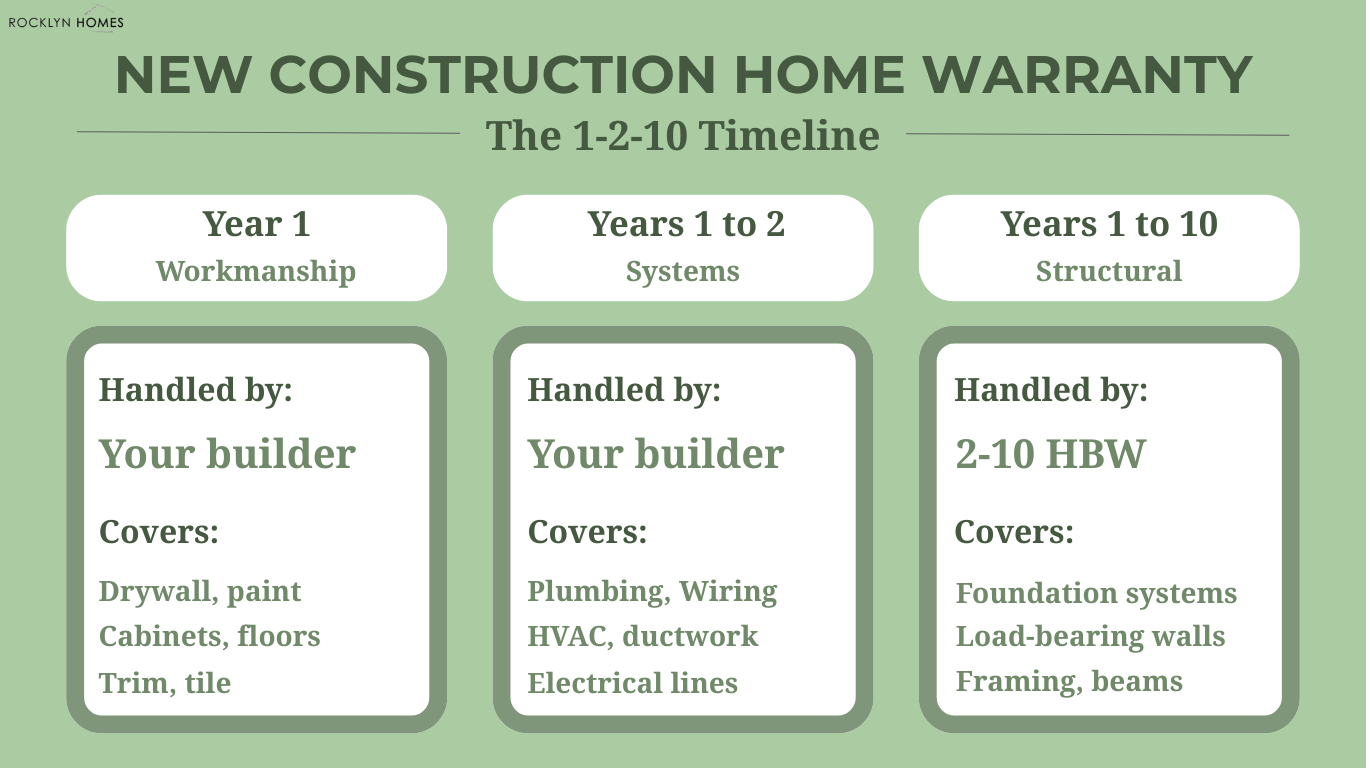
Most builders, including Rocklyn Homes, follow the 1-2-10 model. The three numbers stand for three coverage periods. Each one protects a different part of your new home. The table below shows how warranty coverage builds over time.
| Coverage Period | What It Protects | Who Handles It |
| Year 1 | Workmanship and materials | Your builder |
| Years 1 to 2 | Distribution systems | Your builder |
| Years 1 to 10 | Major structural defects | Structural warranty insurer |
Year 1: Workmanship and Materials
The one-year warranty covers the fit and finish of your home. This includes interior trim, drywall, paint, cabinets, countertops, flooring, and tile. If one of these items does not meet the builder’s construction standards during the first year, the builder repairs or replaces it. Most workmanship issues show up early, so this period matters for catching small problems.
Years 1 to 2: Systems Coverage
The two-year warranty covers the distribution systems hidden behind your walls. This includes the wiring, piping, and ductwork in your electrical, plumbing, and mechanical systems. The coverage gives a new homeowner added protection during early ownership. A failure in a covered system during this window is repaired under the warranty.
Years 1 to 10: Structural Coverage
The 10-year warranty protects the load-bearing parts of your home against a major structural defect. Covered items include foundation systems, load-bearing walls, beams, columns, girders, and roof framing. A structural element qualifies when it carries the weight of the home and fails to do its job. About 1 in 4 new homes experiences a structural defect, with an average repair cost near $50,000. That is why a long structural warranty matters to buyers.
What Is Not Covered by a Builder Warranty?
A builder warranty is a limited warranty. It covers a construction defect, not every issue that can come up in a home. Knowing the gaps helps you avoid surprises.
- Normal wear and tear is your responsibility: Fading paint, worn carpet, and minor settling cracks fall outside warranty coverage.
- Routine maintenance falls on the homeowner: Tasks such as changing HVAC filters, caulking, and seasonal upkeep are part of owning a home.
- Appliances carry their own manufacturer’s warranty: Each appliance comes with paperwork at closing, and the manufacturer warranty handles repairs to the unit itself.
- Weather and accidents are an insurance matter: Damage from storms, fire, or flooding is covered by homeowners insurance, not the builder warranty.
- Homeowner changes can remove coverage: Alterations or repairs you make yourself may take an item out of the warranty.
Skipping required upkeep can also count as a material violation of the warranty terms, so keep your maintenance records in one place.
How Does a New Construction Warranty Work Over Time?
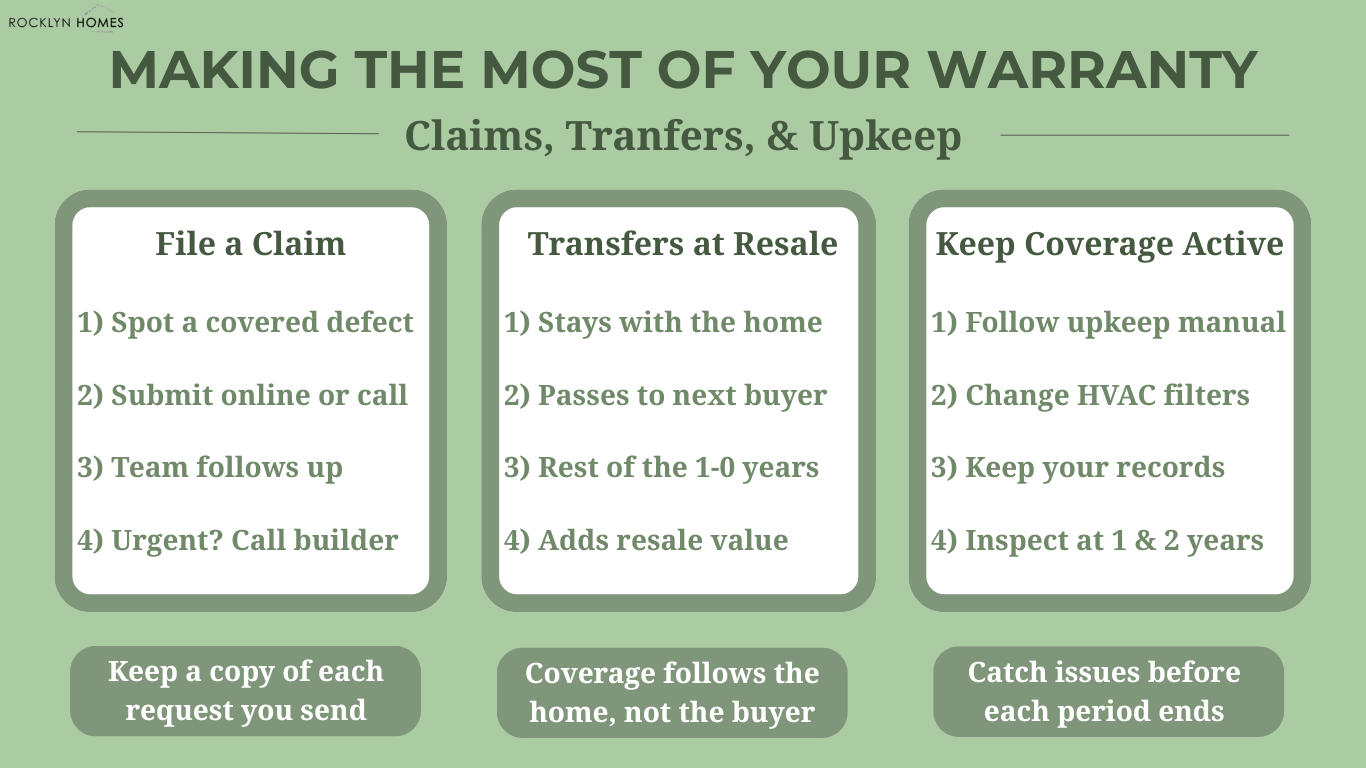
Your coverage works best when you know how to act on it.
How Do You File a Warranty Claim?
Filing warranty claims is straightforward. With Rocklyn Homes, you submit a warranty request online or call Customer Care, describe the concern, and a team member follows up with next steps. For an urgent health or safety problem, call the builder directly. Keep a copy of every request you send.
Does the Warranty Transfer to a New Owner?
Yes. A structural warranty stays with the home, not the first buyer. If you sell during the coverage term, the protection passes to the subsequent purchaser for the rest of the 10-year period. That transfer adds value for sellers and gives the next home buyer added confidence.
How Do You Keep Your Coverage in Good Standing?
Good records and steady upkeep keep your warranty active. Follow the homeowner maintenance manual that comes with your home. A professional home inspection before the one-year and two-year marks can catch covered problems before those periods end.
Rocklyn Homes: Your Partner in New Construction Home Warranty Coverage

A new construction home warranty gives you a clear plan for the rare times something goes wrong. The 1-2-10 structure covers workmanship for one year, systems for two years, and structural elements for ten years, all starting at closing. Knowing what falls outside the plan helps you care for your home and use your coverage well.
Every Rocklyn Homes property is enrolled in our warranty program at closing, backed by 2-10 Home Buyers Warranty, a structural warranty leader with more than 40 years in the field. Rocklyn covers your first year of workmanship and two years of systems, while 2-10 HBW insures qualifying structural defects for a full ten years.
Ready to find a brand-new home built with lasting quality? Explore Rocklyn Homes townhomes and single-family homes in Georgia and Florida, or contact our team to learn more today.
What does a new construction home warranty cover?
A new construction home warranty covers defects in a newly constructed home under a 1-2-10 structure. The builder covers workmanship for one year and systems such as plumbing and electrical for two years. A structural warranty insurer then covers major structural defects for ten years, starting at closing.
How long is a builder warranty on a new home?
Most builder warranties last up to ten years, but the coverage changes by year. Workmanship is covered for one year, systems for two years, and major structural defects for ten years. The 10-year structural term is the longest part of the warranty.
Is a new construction warranty the same as homeowners insurance?
No. A new construction warranty repairs a covered construction defect, such as a faulty load-bearing wall. Homeowners insurance pays for damage from events like fire, theft, or storms. Most buyers carry both.
Does a new home warranty transfer to the next owner?
Yes. The structural warranty transfers to the subsequent purchaser if you sell during the coverage period. The new owner keeps protection for the remaining years of the 10-year structural term, which can make your home more appealing at resale.
What is not covered by a new construction home warranty?
A new construction home warranty does not cover normal wear, routine maintenance, or storm and accident damage. Appliances are handled by the manufacturer’s warranty, and weather damage falls under homeowners insurance.